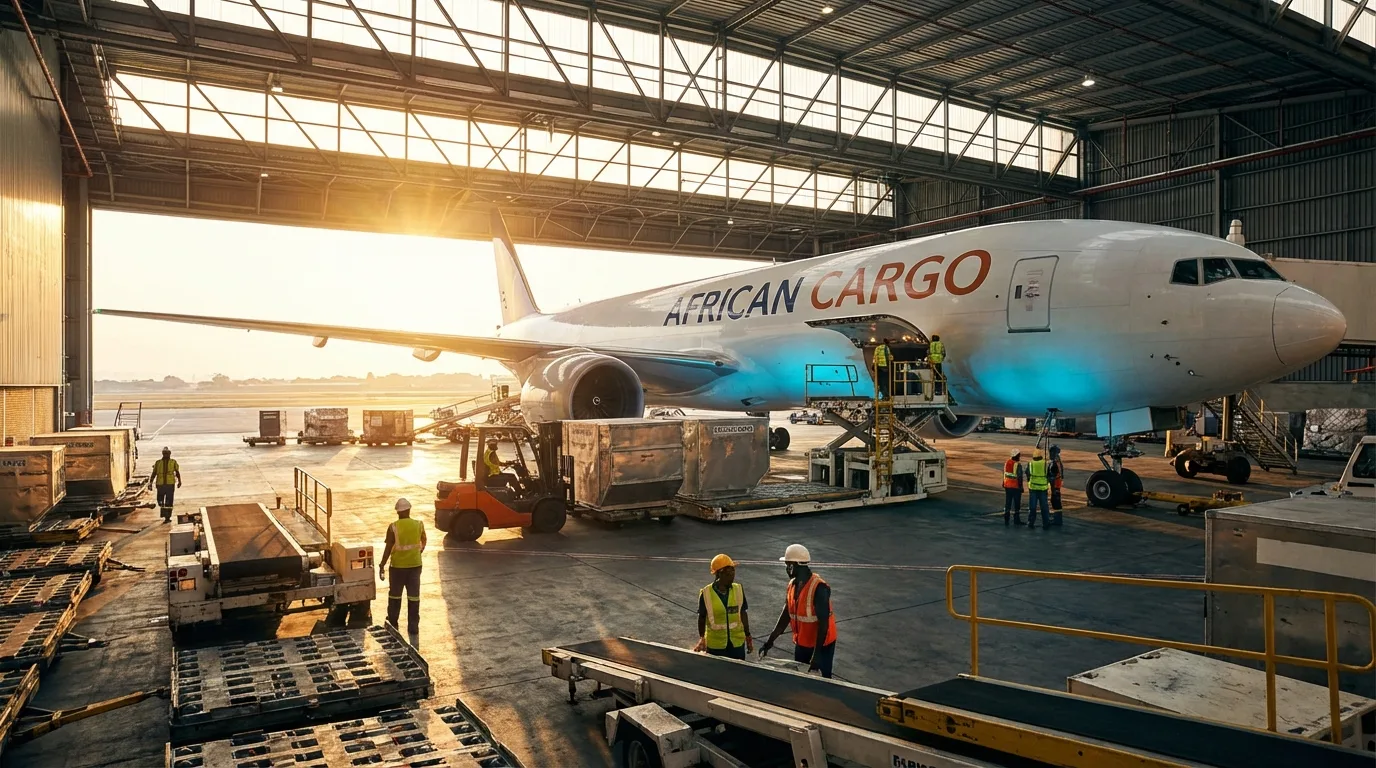
African airlines recorded the fastest air cargo growth globally in January 2026, posting an 18.2% year-on-year increase in cargo traffic. This marks the seventh consecutive month of double-digit gains for the region, significantly outpacing the global average of 5.6% growth.
The surge positions Africa as the standout performer in a polarised market where regional fortunes diverged sharply. While carriers in Africa, the Middle East, Asia-Pacific, and Europe all reported growth above the global average, American carriers posted their sixth consecutive monthly contraction.
Africa-Asia Route Drives Regional Growth
The primary engine behind Africa’s exceptional performance was the Africa-Asia trade lane, which exploded with 41.6% year-on-year growth compared to January 2025. This rebound on a previously underutilised corridor demonstrates how emerging trade routes are reshaping global cargo flows.
Despite this dramatic growth, the Africa-Asia route still represents just 1.3% of global market share, indicating substantial room for expansion. African airlines increased capacity by 6.5% to meet demand, though the region’s cargo load factor remained at 43.5%-below the global average of 45.1%.
Global Market Shows Start to 2026
The broader air cargo market demonstrated resilience at the start of 2026. Global cargo demand measured in cargo tonne-kilometres rose 5.6% compared to January 2025 levels, with international operations performing even stronger at 7.2% growth.
Capacity expanded 3.6% globally and 5.7% for international routes, hitting record January levels. The overall cargo load factor edged up to 45.1%, reflecting tighter capacity management across the industry.
“The demand for air cargo had a start to 2026, recording 5.6% year-on-year growth in January. At the regional level, the story is more polarised. Carriers in Africa, Middle East, Asia-Pacific, and Europe all reported faster growth than the global average. In contrast, carriers in the Americas reported aggregate contractions.”
– Willie Walsh, IATA Director General

Regional Performance: Winners and Losers
The January data revealed stark regional differences in cargo performance:
- Africa: 18.2% demand growth, 6.5% capacity increase
- Middle East: 9.3% demand growth, 9.9% capacity increase
- Asia-Pacific: 7.8% demand growth, 3.3% capacity increase, commanding 35.9% world share
- Europe: 6.9% demand growth, 4.9% capacity increase, holding 21.4% world share
- North America: 0.5% demand decline, 0.2% capacity decrease, maintaining 24.5% world share
- Latin America and Caribbean: 2.0% demand decline, despite 2.3% capacity increase
Asia-Pacific remained the primary engine of industry expansion, though its 7.8% growth represented the weakest rate since 2020, suggesting possible capacity fatigue in the region.
Trade Lane Analysis: Uneven Performance
Performance across major trade corridors showed significant variation. While several routes posted double-digit growth, others faced headwinds:
Strong Performers
- Europe-Asia: 15.2% growth, marking 35 consecutive months of expansion with 21.5% market share
- Within Asia: 14.3% growth, continuing 27 consecutive months of gains with 7.3% market share
- Middle East-Asia: 12.9% growth, extending 11 consecutive months of increases with 7.4% market share
- Europe-Middle East: 10.2% growth, holding 5.2% market share
- Europe-North America: 3.8% growth, maintaining 24 consecutive months of expansion with 13.5% market share
Weak Performers
The Asia-North America trade lane declined 0.6% despite commanding the second-largest market share at 23.4%. This deterioration reflects ongoing tariff-driven distortions and trade policy uncertainties affecting trans-Pacific flows.
Supporting Economic Factors
Several macroeconomic indicators supported the January cargo growth:
- Global goods trade grew 4.9% year-on-year in December 2025
- Jet fuel prices decreased 6.5% year-on-year in January, reducing operating costs
- Global manufacturing PMI rose to 51.8, its highest level in over 18 months
- PMI for new export orders climbed to 49.9, approaching expansion territory
These tailwinds contributed to improved operating conditions for cargo carriers, though the benefits were distributed unevenly across regions.
Outlook: Challenges Ahead
Despite the strong January performance, the outlook for 2026 remains cautious. IATA forecasts global air cargo traffic to grow by just 2.4% in 2026-significantly slower than recent years. African carriers, which recorded 6% growth across 2025, face the challenge of maintaining momentum.
Two major risk factors dominate the forward view: evolving US trade policies continue to create uncertainty in trans-Pacific and trans-Atlantic flows, whilst the outbreak of hostilities in the Middle East threatens to global supply chains.
“The resilience of air cargo will continue to be tested in the coming months. In addition to the long-running uncertainties of evolving US trade policies, the outbreak of hostilities in the Middle East will both weigh heavily on global supply chains. Addressing these topics will add extra importance to discussions at the upcoming World Cargo Symposium in Lima, Peru (10-12 March 2026), where strengthening air cargo’s adaptability and efficiency through digitalisation and other measures will be a key focus.”
– Willie Walsh, IATA Director General
What This Means for Forwarders
The dramatic shift in trade lane performance creates new opportunities for freight forwarders with the right tools. Africa-Asia routes now offer explosive growth potential, whilst traditional trans-Pacific lanes face headwinds.
Forwarders need instant access to multi-carrier options across emerging corridors. Complex routing that once took hours to quote must now be assembled in minutes. The ability to compare rates across multiple carriers and book both airport-to-airport (A2A) and door-to-door (D2D) options in one workflow separates winners from those left behind.
As trade lanes evolve, forwarders need tools that allow them to compare multiple carriers quickly, build complex routings, and secure capacity before rates shift. Platforms that streamline quoting and booking across trusted partners will play an increasingly important role as emerging corridors like Africa–Asia expand.
The cargo market is shifting. Move first and fast.