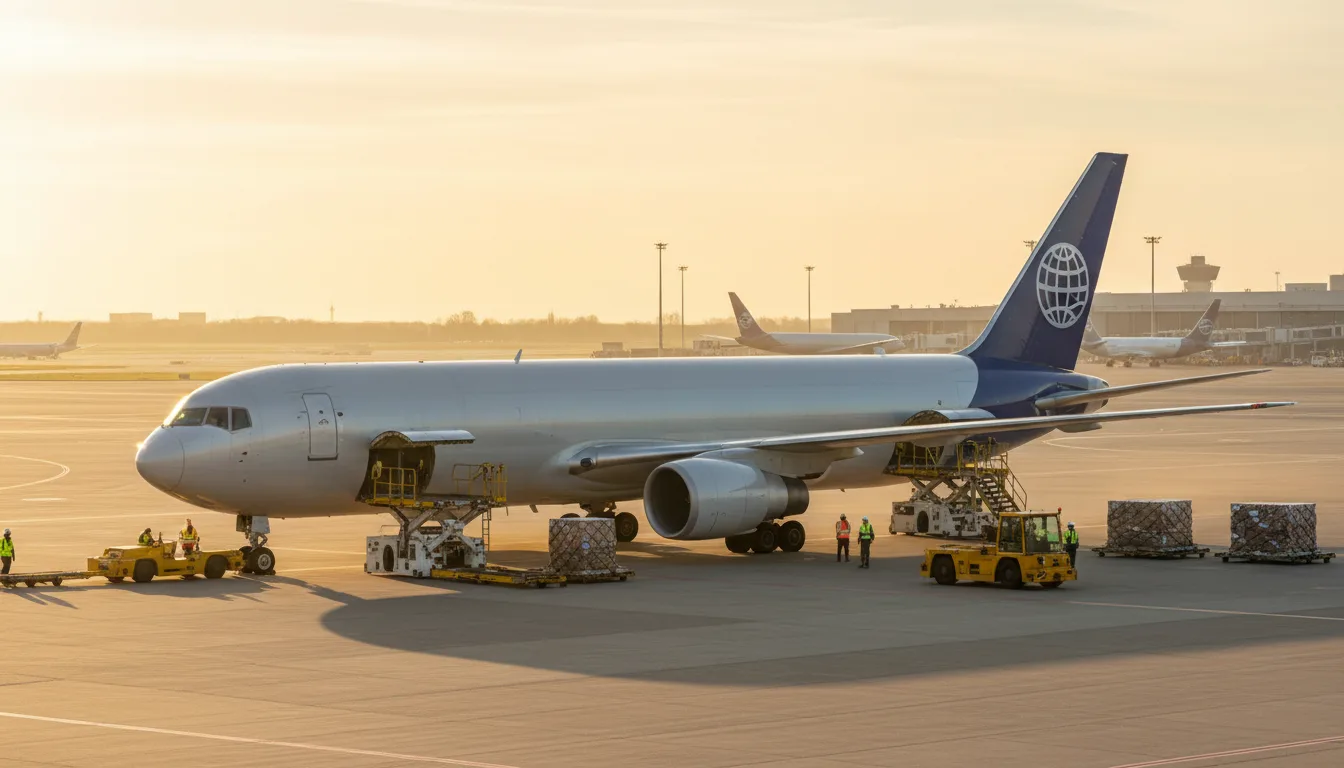
TL;DR Air freight from London Heathrow (LHR) to Los Angeles (LAX) is available via Cargo Solutions Network as A2A, D2D, A2D, and D2A services, with zero subscription fees for forwarders. Airport-to-airport transit typically runs 1-5 days; door-to-door moves, once export clearance, US customs, and final-mile delivery are included, commonly take 3-5 days under normal conditions. CSN aggregates capacity across multiple carriers on this corridor so forwarders can search, compare, and book online without any membership or per-booking charge.
Route Overview: London Heathrow to Los Angeles
London Heathrow (LHR) is one of the world’s busiest international air cargo hubs, with a wide spread of freighter and belly-hold capacity operating across transatlantic lanes every day. Its cargo infrastructure handles everything from temperature-controlled pharmaceuticals to high-value electronics, and its proximity to London’s logistics belt gives it strong road-feeder connections across England, Wales, and the Midlands. For UK exporters or forwarders consolidating shipments from across Britain, LHR is typically the natural departure gateway for time-critical transatlantic cargo.

Markets move fast. Your quoting should too.
See live rates, compare options and manage shipments in one workflow.
Los Angeles International (LAX) is a primary cargo gateway on the US West Coast and one of the busiest air freight entry points in North America. Beyond the airport itself, the Greater Los Angeles area functions as a major distribution hub for the western United States, with onward trucking access to Southern California, Nevada, and the broader Pacific region. Cargo arriving at LAX can be cleared, deconsolidated, and redistributed efficiently, which is why it attracts a high volume of high-value and time-sensitive imports from Europe.
Door-to-door on this corridor spans more than the transatlantic flight. A UK collection can involve a road leg from the shipper’s premises to an LHR cargo terminal; on the US side, drayage from LAX to a final delivery address in Los Angeles or further inland adds further time and cost. Forwarders managing this lane need to account for UK export formalities, US Customs and Border Protection (CBP) import entry, and the practical realities of both airport’s cargo handling schedules when quoting realistic transit windows to their clients.
| Origin airport | London Heathrow (LHR), United Kingdom |
|---|---|
| Destination airport | Los Angeles International (LAX), United States |
| Service types | A2A (Airport-to-Airport), D2D (Door-to-Door), A2D (Airport-to-Door), D2A (Door-to-Airport) |
| Typical transit (A2A) | 1-5 days (airport-to-airport, including handling and customs) |
| Typical transit (D2D) | 3-5 days under normal conditions; broader planning range 5-10 days depending on service level and clearance |
| Key carriers | Multiple scheduled passenger and freighter operators on the LHR-LAX corridor (available via CSN) |
| Common cargo | High-value goods, electronics, pharmaceuticals, fashion samples, urgent spares, perishables, time-sensitive shipments |
Featured Route on CSN
LHR → LAX – Air Freight London Heathrow to Los Angeles
The LHR-LAX corridor benefits from frequent flight departures, giving forwarders genuine flexibility on uplift timing. The flight itself – the fastest part of the entire move – runs at roughly 10 hours 21 minutes on the quickest published nonstop services, with WTA Group noting that UK-US flights generally take between 7 and 11 hours. That flight time, however, is not the transit time that matters for cargo planning: it is the handling, screening, export declaration, customs entry, and final-mile leg that determine when freight actually arrives at its destination.
For airport-to-airport bookings, transit is typically quoted in the 1-5 day range on international long-haul lanes, accounting for cut-off times, cargo acceptance, and US customs processing at LAX. For door-to-door shipments, WTA Group cites a practical planning figure of around 3-4 days for the full UK-to-US process under normal conditions, while Freightos notes that air freight broadly runs 5-10 days when all steps are included. The right answer for any specific shipment depends on the service level selected, documentation accuracy, and whether there are any CBP holds or screening delays.
CSN aggregates capacity from multiple carriers operating this corridor, so forwarders using the platform can compare options across service levels and transit windows without calling individual sales desks or working through manual rate requests. All searches, comparisons, and bookings are free – no subscription, no membership fee, no per-booking surcharge.

Service Options: A2A vs D2D
| Service | Includes | Typical Transit | Best For |
|---|---|---|---|
| A2A (Airport-to-Airport) | Cargo acceptance at LHR through to freight release at LAX; does not include UK collection or US delivery | 1-5 days | Forwarders managing their own collection and delivery; shippers with established US customs brokers; consolidations |
| D2D (Door-to-Door) | UK collection, export clearance, air freight, US customs clearance, and final delivery to the US address | 3-5 days typical; up to 5-10 days in broader planning scenarios | Shippers who want a single point of responsibility for the entire move; time-sensitive but fully managed shipments |
| A2D (Airport-to-Door) | Cargo acceptance at LHR through to final delivery at the US destination address, including US customs | 2-6 days depending on delivery location and clearance | Shippers who can deliver to LHR but need US delivery arranged; importers without their own US drayage |
| D2A (Door-to-Airport) | UK collection and export clearance through to freight release at LAX; US collection from airport arranged separately | 2-5 days to LAX release | US-based consignees with their own customs broker and drayage; large importers managing their own US logistics |
Key Considerations for This Route
Customs and Documentation: UK Export and US Import
Documentation accuracy is the single biggest controllable risk on this lane. Errors at either end – UK export or US import – are a leading cause of delays, and both jurisdictions have specific requirements that must be met before cargo moves.
- Air Waybill (AWB) – must accurately reflect the shipment contents, weight, dimensions, and declared value
- Commercial Invoice – required by both HMRC for UK export and CBP for US import entry; must include seller and buyer details, accurate commodity description, country of origin, and declared value in the correct currency
- Packing List – itemised breakdown of contents, quantities, and packaging; must align exactly with the commercial invoice
- UK Export Declaration – required for goods leaving Great Britain; submitted via HMRC’s Customs Declaration Service (CDS)
- US Entry Documentation – CBP requires a formal entry for commercial shipments above the de minimis threshold; your US customs broker files this against the AWB and commercial invoice
- EORI Number – the UK exporter needs a valid EORI number registered with HMRC
- Commodity / HTS Code – correct classification under both the UK Global Trade Tariff and the US Harmonized Tariff Schedule is essential; misclassification triggers holds and potential penalties
- Licences and permits – certain goods (dual-use items, controlled substances, CITES-regulated products) require export licences from the UK Export Control Joint Unit or equivalent US import authorisation
LAX as a West Coast Distribution Gateway
Los Angeles is not just a destination – it is a distribution hub. Freight clearing LAX can move by road to addresses across Southern California within hours, and onward to Nevada, Arizona, or further inland within one to two days. Forwarders quoting D2D or A2D services should factor in drayage lead times, particularly during peak port congestion periods when LAX cargo terminals can experience handling backlogs. Building at least one buffer day into US-side delivery estimates is prudent for time-sensitive shipments.
Cargo Types Best Suited to LHR-LAX Air Freight
Air freight on this corridor is chosen for speed and reliability, not lowest cost. Typical cargo types include high-value electronics, pharmaceutical products, fashion samples and seasonal collections, urgent industrial spares, and perishable goods. The cost of air freight over ocean freight is justified when the value of the goods, the cost of delay, or the shelf life of the product makes transit time the primary concern. Bulk, low-value, or non-time-sensitive cargo is generally better suited to ocean freight via Southampton or Felixstowe to East or West Coast US ports.
SUBSCRIBE TO FAST FORWARDER
YOUR INDUSTRY INTELLIGENCE HUB
Fast Forwarder gives you weekly market insights, rate trends and industry intelligence.
*UNSUBSCRIBE ANYTIME. WE DON’T SEND SPAM.

Temperature-Sensitive and Pharmaceutical Cargo
Both LHR and LAX have dedicated cool-chain handling facilities, making the corridor viable for pharmaceutical, biotech, and perishable shipments that require controlled temperature environments in transit. However, forwarders managing temperature-sensitive cargo on this lane need to confirm cold-chain continuity at every handover point – including road collection in the UK, cargo terminal dwell time at LHR, the flight itself, and drayage from LAX. GDP (Good Distribution Practice) compliance documentation, temperature monitoring records, and packaging qualification data should be prepared in advance. Any gaps in the cool-chain record can result in cargo rejection at the US end, particularly for regulated pharmaceutical products subject to FDA oversight.
Why Ship London Heathrow to Los Angeles with Cargo Solutions Network
Cargo Solutions Network is a free digital freight platform built specifically for forwarders. There are no subscription fees, no membership fees, and no per-booking surcharges – ever. CSN aggregates air cargo capacity across multiple carriers covering 10,000-plus routes in more than 150 countries, so forwarders working the LHR-LAX corridor can search available options, compare rates across service levels, and book online without manual rate requests or waiting on sales desk callbacks. The platform covers A2A, D2D, A2D, and D2A services on this route, giving forwarders the flexibility to match the right service type to each shipment.
CSN has no shipper-facing marketplace. Forwarders are the customer – there is no channel conflict, and no risk that a platform is selling direct to your clients. The platform was built by freight people, for freight people, and the workflow reflects that: straightforward search, transparent comparison, and online booking without unnecessary steps. Get a quote at cargosolutionsnetwork.com.
Frequently Asked Questions
How long does air freight from Heathrow to LAX actually take?
The nonstop flight runs at around 10-11 hours, but that is not the figure that matters for cargo planning. Airport-to-airport transit – including cargo acceptance, handling, and US customs processing – is typically 1-5 days on this lane. Door-to-door, once UK collection, export clearance, the flight, US import entry, and final delivery are included, a practical planning figure cited by UK freight forwarders is around 3-4 days under normal conditions. Freightos notes that air freight broadly runs 5-10 days when all steps are factored in, though the LHR-LAX corridor with its frequent departures and strong handling infrastructure tends to perform towards the faster end of that range.
What documents do I need for air freight from the UK to the US?
Core documents required for an LHR-LAX air freight shipment include the Air Waybill (AWB), commercial invoice, and packing list – all three must be consistent and accurate. On the UK side, an export declaration must be submitted via HMRC’s Customs Declaration Service, and the exporter needs a valid EORI number. On the US side, a formal CBP entry is required for commercial shipments above the de minimis threshold, typically filed by a licensed US customs broker using the AWB and commercial invoice. Correct commodity classification under both the UK Global Trade Tariff and the US Harmonized Tariff Schedule is essential – misclassification is a common cause of customs holds. Goods subject to export controls, CITES regulations, or US import licensing requirements will need additional documentation.
Can I ship temperature-sensitive or pharmaceutical cargo on the LHR-LAX route?
Yes. Both London Heathrow and Los Angeles International have dedicated cool-chain handling facilities, and the corridor is used regularly for pharmaceutical, biotech, and perishable shipments. Forwarders managing temperature-sensitive cargo need to confirm cold-chain continuity at every handover point – UK collection, LHR terminal dwell, the flight, and LAX drayage. GDP compliance documentation and temperature monitoring records should be prepared in advance. FDA-regulated pharmaceutical products will face additional scrutiny at US import, so documentation must be complete and correct before the shipment moves.
Is LAX a good destination for onward distribution across the US?
LAX is one of the primary air cargo gateways on the US West Coast and functions as a distribution hub for the wider region. Freight clearing LAX can reach addresses across Southern California within hours and extend to Nevada, Arizona, and other inland states within one to two days by road. Forwarders quoting door-to-door or airport-to-door services should build in a buffer for drayage lead times, particularly during periods when LAX cargo terminals are under higher volume pressure.
What types of cargo are best suited to air freight on the LHR-LAX corridor?
Air freight on this lane is chosen for speed and reliability, not the lowest possible unit cost. Cargo types that regularly move on LHR-LAX air freight include high-value electronics, pharmaceuticals, fashion samples and seasonal collections, urgent industrial spares, and perishables. The economics work when the value of the goods, the penalty for delay, or the product’s shelf life makes transit time the overriding factor. Bulk, low-value, or non-time-sensitive freight is generally better suited to ocean freight services departing from UK ports.