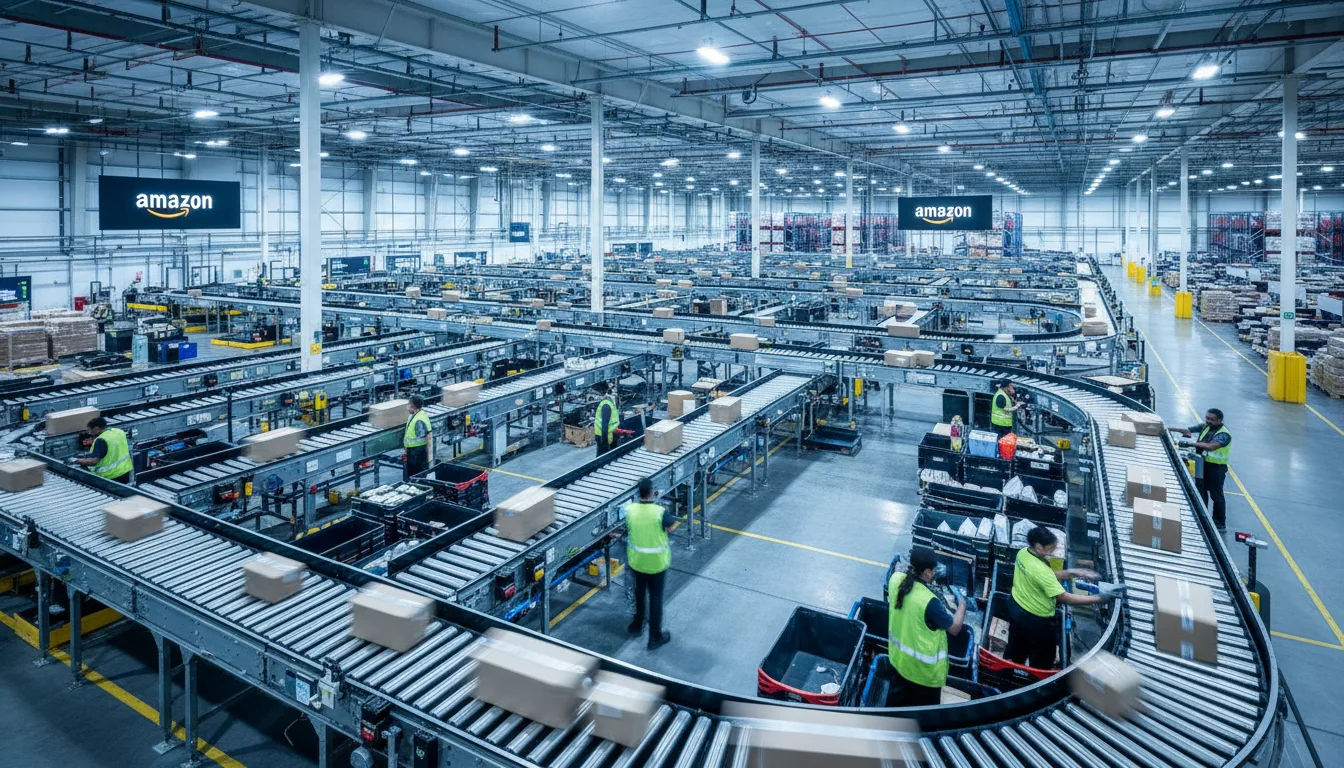
The parcel delivery landscape is shifting beneath our feet. Amazon is projected to ship 8.4 billion parcels domestically in 2028, edging past the U.S. Postal Service’s projected 8.3 billion. What once seemed impossible is now inevitable.
A decade ago, industry executives dismissed the idea. Today, Amazon delivers nearly 6 billion parcels annually. UPS handles 5.2 billion. FedEx manages 3.3 billion. The former customer has become the largest competitor.
How Amazon Built the Largest Delivery Network in America
Amazon’s rise from marginal player to market leader took less than five years. At the end of 2019, the company delivered around 2 billion parcels, roughly even with FedEx but significantly behind UPS at nearly 5 billion.
By 2021, Amazon reached 4.5 billion parcels, surpassing FedEx’s 3.4 billion whilst UPS held steady at 5.5 billion. The COVID-19 pandemic accelerated this trajectory as lockdowns drove online shopping volumes to unprecedented levels.
“Since we began tracking shipments in 2015, the parcel market had been dominated by the Big 3: FedEx, UPS, and USPS. However, Amazon Logistics – once a small competitor – is closing the gap rapidly.”
– Pitney Bowes Parcel Shipping Index
Amazon built one of the world’s largest logistics networks by establishing sorting centres, warehouses and delivery facilities across the United States. The company’s capacity tripled from 2 billion parcels in 2019 to nearly 6 billion in 2023.
Same-Day Delivery Drives Market Position
Amazon introduced same-day delivery in 2009 in just seven cities: Boston, New York, Philadelphia, Baltimore, Washington D.C., Las Vegas and Seattle. The launch of Amazon Prime in 2015 catalysed the establishment of nearly 60 delivery hubs nationally.
As of 2023, same-day delivery is available in approximately 90 metropolitan areas. The expansion strategy centres on smaller warehouses closer to customers, enabling faster fulfilment in growing urban markets.
In 2022, Amazon unveiled autonomous mobile robot technology designed to speed up product packaging. Automation investment positions the company to handle growing volumes without proportional cost increases.
Incumbent Carriers Shift Strategy
Amazon’s outsize growth combined with strategy shifts at FedEx and UPS have changed the balance. UPS plans to cut Amazon volume it delivers in half by next year, choosing to focus on more profitable customer segments instead.
This strategic retreat creates both challenge and opportunity. Amazon must build additional capacity to replace what UPS will no longer handle. The company is expanding beyond its own marketplace deliveries through Amazon Shipping service to compete directly with incumbent carriers for third-party business.
“A decade ago Amazon was a major customer for UPS and FedEx, and some executives from the incumbents and analysts mocked the notion that it could someday supplant them.”
Pricing Pressure Across the Market
The parcel delivery market is experiencing intense pricing pressure. Revenue per parcel dropped from $9.10 in 2023 to $9.09 in 2024. Modest as it seems, this decline signals broader competitive dynamics.
Alternative delivery providers shipped 780 million U.S. parcels in 2024, up 22.6% year over year. These carriers are taking share by offering lower prices and flexible service models. USPS is fighting back with new services like Ground Advantage and securing more direct customer contracts.
USPS handled 6.9 billion parcels in 2024, marking the first year-over-year volume growth since 2020. The Postal Service remains a formidable competitor with unmatched residential reach and competitive pricing.

Global Market Dynamics and Technology Investment
The transformation playing out in America mirrors global trends. The worldwide parcel delivery market is projected to reach USD 700 billion by 2030, expanding from USD 340 billion in 2022 at a 9.4% compound annual growth rate.
The U.S. market alone was valued at USD 110 billion in 2024 and is expected to reach USD 170 billion by 2033 with a 5.8% CAGR. Peak season delivery volumes increase by 40% during holidays, with 2.3 billion packages projected for the 2026 peak season.
Automation and AI Transform Operations
Major carriers are investing heavily in technology to maintain competitive position:
- FedEx maintains annual global revenues exceeding $90 billion with coverage in over 220 countries
- UPS generates revenues surpassing $80 billion and is investing over $400 million through 2028 in network automation
- DHL Express produces revenues of $25+ billion serving international markets
Automated sorting facilities increase throughput by 50-100% in primary hubs. AI and machine learning integration enables route optimisation and predictive capacity planning. These systems are no longer experimental-they’re operational necessities.
Sustainability Becomes Operational Imperative
Consumer expectations are shifting delivery economics. 73% of consumers prioritise fast delivery, whilst 57% prefer companies with green practices. Carriers must deliver both speed and sustainability.
FedEx has pledged $2 billion toward carbon-neutral operations by 2040. Electric vehicle fleets are expanding across major carriers. What began as competitive differentiation has evolved into operational necessity.
Emerging Carriers Challenge Traditional Models
New entrants are established logistics through customer experience focus. Veho has achieved a 99%+ on-time delivery rate through technology-focused operations. The company is expanding parcel sorting capacity by over 50% in key markets for 2026.
Companies achieving 99%+ on-time rates outperform competitors by 40% on customer retention. Speed and reliability translate directly to commercial advantage.
What This Means for Freight Forwarders
Amazon’s ascent reshapes competitive dynamics across the entire logistics sector. Parcel volume that once moved through integrated carriers is migrating to Amazon’s network. Traditional partnerships are dissolving as strategic priorities diverge.
For freight forwarders, this market transformation creates both pressure and opportunity. Capacity access, competitive pricing and service flexibility become more critical as market concentration increases amongst a changing roster of dominant players.
The carriers that will thrive are those that move fast, quote accurately and book capacity before competitors. Speed wins cargo. Direct access wins margin.
The parcel market Amazon is dominating today signals where broader logistics competition is heading tomorrow. Quote faster. Ship smarter. Win more business.