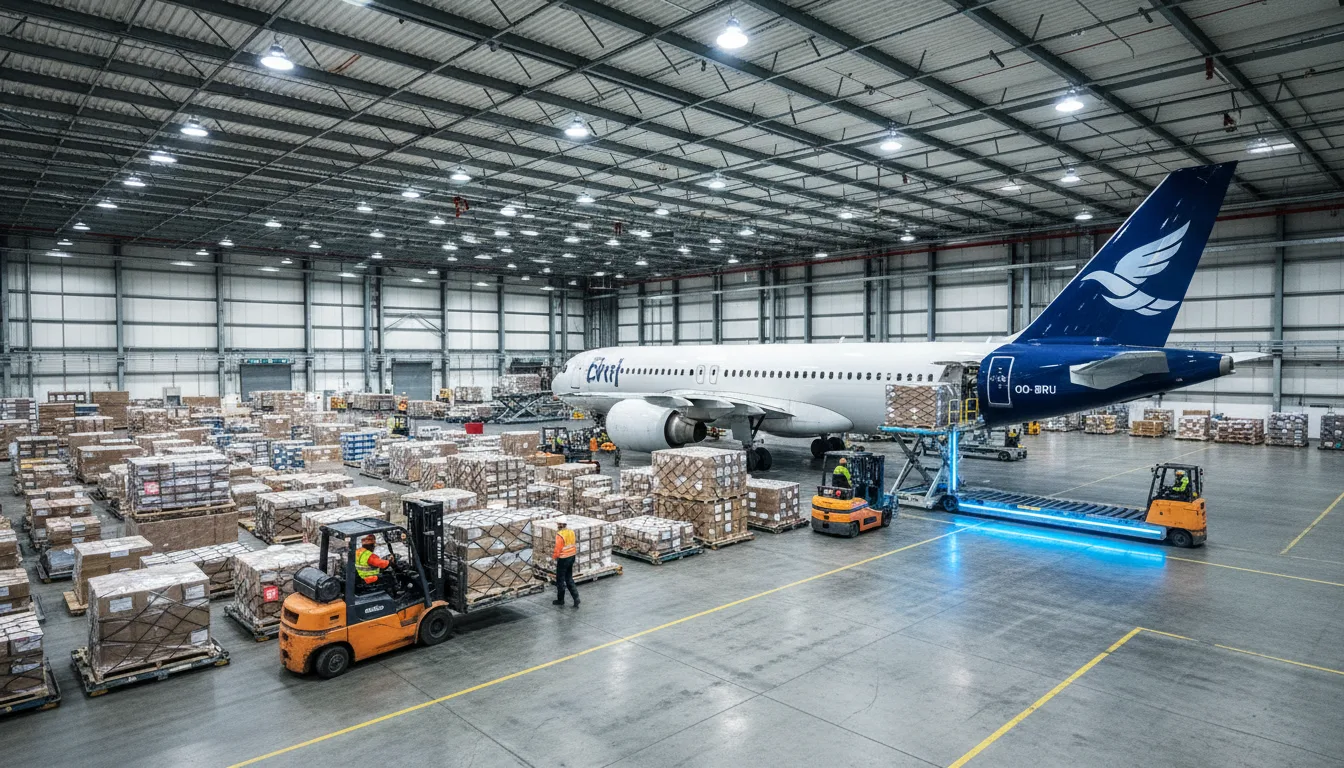
Brussels Airport closed 2025 with cargo performance and steady passenger growth, handling 795,000 tonnes of freight and 24.4 million passengers despite facing seven national strikes that cancelled 2,400 flights. The Belgian hub maintained momentum into 2026, with January and February figures showing continued expansion across both cargo and passenger operations.
Strong cargo performance drives growth
Cargo operations delivered standout results throughout 2025. Total freight volumes jumped 8.5% to 795,000 tonnes, fuelled by double-digit increases in express services and air cargo transport. The airport’s expanded pharmaceutical logistics infrastructure and temperature-controlled facilities strengthened its competitive position in high-value freight segments.
Air cargo transport grew 11.5% whilst belly cargo climbed 9.2%. Express services surged 22.3%, reflecting booming e-commerce demand and time-critical shipments. Full freighter operations rose modestly by 0.8%, whilst trucked cargo volumes fell 6.7% as shippers shifted to direct air routes.
The cargo momentum continued into early 2026. January saw freight volumes rise 3.5% to 61,485 tonnes, with belly cargo up 5.1% and express services climbing 10%. February delivered 6.5% cargo growth, maintaining the upward trajectory established in 2025.
Passenger traffic grows despite strike
Brussels Airport handled 24.4 million passengers in 2025, a 3.3% increase from 23.6 million in 2024. Growth would have been stronger without industrial action. Seven national union strikes forced the cancellation of 2,400 flights and resulted in 275,000 fewer travellers passing through the terminal.
“2025 was a year of further growth, a stronger network and the launch of the first phase of Hub 3.0, our large-scale investment project to improve the airport experience for our passengers. Despite the challenges we faced, such as national strikes and a cyber incident at one of our suppliers, we remained focused on our core task: connecting people, businesses and communities.”
– Arnaud Feist, CEO of Brussels Airport
January 2026 delivered 1,601,051 passengers, up 5.5% year-on-year. The airport benefited from strong post-Christmas travel demand and diverted flights from Dutch airports temporarily closed due to extreme weather across northwestern Europe. December 2025 recorded 1.843 million passengers, a 3.9% increase driven by holiday travel.
Aircraft utilisation improves
Load factors improved across the year. Average passengers per flight rose from 131 to 135 between January 2025 and January 2026. Annual figures showed 145 passengers per flight in 2025 compared to 144 in 2024. Airlines are deploying larger aircraft and filling more seats per departure.
Total flight movements grew 2.8% to 198,000 in 2025. Passenger flights increased whilst dedicated cargo flights fell, reflecting industry trends toward better aircraft utilisation and belly cargo opportunities on passenger services.

Network expansion strengthens connectivity
Brussels Airport expanded its global reach in 2025 with three new carriers and six new destinations. Cathay Pacific, Air Senegal, and Smartwings joined the network, adding routes to:
- Atlanta – strengthening North American connectivity
- Chongqing and Hong Kong – expanding Asian coverage
- Bordeaux and Larnaca – adding European options
- Scandinavian Mountains Airport – serving winter sports demand
The airport maintains its role as a key hub between Europe, Africa and North America. Transfer passengers accounted for 18% of January traffic and 14% of departing passengers annually, particularly on intercontinental routes served by Star Alliance carriers.
Night operations show compliance improvement
Brussels Airport reduced unauthorised night flights by 29% over three years. Flights without proper night slots fell from 1,458 in 2022 to 1,032 in 2025, demonstrating better operational management and regulatory compliance.
The airport operated 15,938 commercial night-time movements in 2025, down from 16,284 in 2024. Total night slot allocation stood at 15,771, below the 16,000 legal maximum. Exempt flights totalled 5,777, including medical, military and delayed services.
Strategic position drives regional growth
Brussels Airport’s performance reinforces its position as a critical economic driver in the Benelux region. The combination of passenger growth, cargo expansion and improved network connectivity supports Belgium’s international trade and business links.
Recent investment in pharmaceutical logistics and temperature-controlled infrastructure positions the airport to capture higher-value cargo flows. Express services growth of 22.3% signals strong demand for time-critical shipments that command premium rates and better margins for freight forwarders.
The airport’s hub role between continents creates opportunities for multi-leg routing and consolidation services. With 85 countries in CSN’s global network and door-to-door coverage expanding to multiple destinations, forwarders can quote complex routes through Brussels faster than traditional email chains and spreadsheet comparisons.
What this means for cargo solutions providers
Brussels Airport’s 8.5% cargo growth and expanding network create new capacity opportunities for independent freight forwarders. The combination of increased belly cargo on passenger services and dedicated freighter operations provides flexible routing options for both airport-to-airport (A2A) and door-to-door (D2D) shipments.
Temperature-controlled infrastructure supports pharmaceutical and perishable cargo movements. Express services growth opens premium service opportunities. New intercontinental routes to Atlanta, Chongqing and Hong Kong expand tradelane options for forwarders serving clients with Asian and North American requirements.
Quote complex European routes faster. Compare A2A and D2D options. Book direct with zero subscription fees. CSN connects you to verified partners and live rates across the open global network.