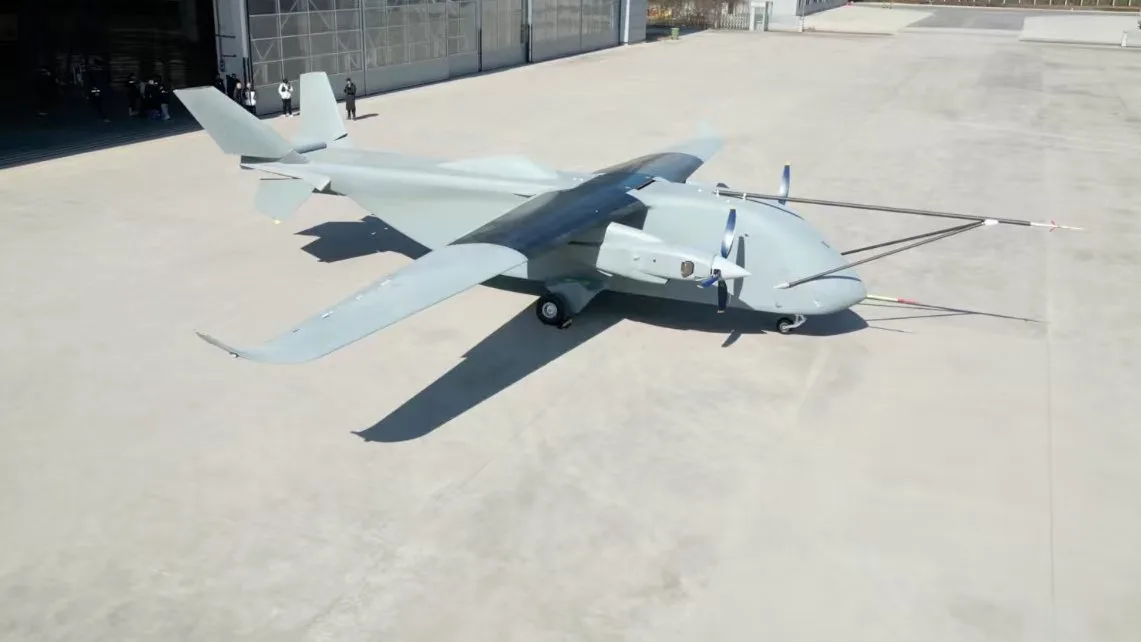
China successfully tested the world’s heaviest cargo drone on Tuesday, marking a significant milestone in unmanned aerial logistics. The Changying-8, also known as NORINCO LUCA, completed its maiden flight at Zhengzhou Shangjie Airport in Henan Province with a 7-tonne take-off weight.
The drone took off after a 280-metre taxi and completed a 30-minute test flight, validating its intelligent flight control, avionics, power systems, and overall flight performance. Developed by state-owned Norinco Group and Beijing Beifang Changying UAV Technology Co., Ltd., this aircraft fills a critical gap in China’s low-altitude logistics capabilities.
Technical Specifications That Matter
The Changying-8 delivers serious cargo capacity. The aircraft weighs 3.5 tonnes with a matching payload capacity of 3.5 tonnes, totalling that 7-tonne take-off weight. At 17 metres long with a 25-metre wingspan, the drone features an 18-cubic metre fully enclosed cargo bay with front and rear doors.
The modular design allows quick engine swapping for different operational scenarios. Range figures vary across sources, with operational capacity between 800 to 1,500 kilometres for standard missions, extending beyond 3,000 kilometres for ferry operations. The aircraft operates continuously 24/7, designed specifically for high-altitude and island operations where traditional logistics face challenges.
“One of our strengths is that we are currently exploring future commercial applications with both domestic and international clients. Our end goal is to establish regular commercial transport routes and bring it to market as soon as possible.”
– Cai Hangqing, Chairman of Northern Changying UAV Technology
Dual-Use Platform for Military and Commercial Markets
The Changying-8 serves both military and civilian purposes. Dubbed an ‘unmanned aerial heavy truck’, the aircraft can be quickly equipped with different mission payloads for emergency communications, weather modification, and electronic reconnaissance alongside standard cargo operations.
Three core target markets drive commercial development:
- Domestic e-commerce logistics – bulk goods distribution and fresh produce transport
- Remote area supply – serving high-altitude plateaus and island regions
- National emergency support – disaster relief and emergency rescue operations
Current low-altitude logistics in China relies primarily on small, lightweight drones. The Changying-8 addresses the gap in large cargo transport, completing what developers call the comprehensive trunk-feeder-last-mile network for aerial logistics.

China’s Rapid Heavy-Lift Drone Development
China launched two heavy-lift drone models within 24 hours of each other, demonstrating accelerated advancement in unmanned cargo transport technology. The Jiutian UAV, designed by Aviation Industry Corporation of China (AVIC), made its inaugural flight in Shaanxi Province with specifications that outpace the Changying-8 in certain metrics.
Competing Platforms in Development
The Jiutian offers a 25-metre wingspan with a 16-tonne maximum takeoff weight. It carries 6,000 kilograms of payload with 12 hours maximum endurance and a ferry range reaching 7,000 kilometres. This long-haul capability suits challenging transportation routes where traditional methods prove costly or impractical.
The AR-E800, tested in Jiangxi Province one day before the Jiutian flight, represents a different approach. This electric vertical takeoff and landing (eVTOL) aircraft features six coaxial rotors and carries 300 kilograms, targeting urban logistics with zero emissions and quieter operations.
Multiple companies are advancing UAV models across the payload spectrum:
- Yitong TP1000: 1,000 kg payload, 26-minute certified flight, 30 orders including ZTO Express
- Boying T1400: 650 kg payload, 8+ hours endurance, operates in -40 to 55°C temperatures
- Air White Whale W5000: 5 tonnes payload capacity (in development)
- CM100: 10 tonnes payload capacity (in development)
Proven Field Performance
Heavy-lift drones are delivering measurable results in challenging environments. In Yunnan Province, drones transported 180 tonnes of tower-building materials in three days – a task that previously required a month using traditional methods.
A fleet operated by China Southern Power Grid moved 2,000 tonnes over 22 kilometres, reducing labour requirements by 60%. In the China-Laos power corridor, drones and helicopters transported 5,000 tonnes of materials to remote construction sites.
Offshore operations show equal promise. A 2-tonne eVTOL aircraft flew cargo from Shenzhen to an oil platform 150 kilometres offshore in under an hour, demonstrating reliable long-distance capabilities over water.
Impact on Global Freight Networks
The Changying-8 and competing platforms represent expanded reach to difficult areas previously underserved by traditional logistics. The technology offers reduced environmental footprint compared to road-based transport, versatile deployment options for time-sensitive cargo, and significant cost savings for operations in remote or challenging terrain.
For freight forwarders, these developments signal new routing options for challenging last-mile deliveries, emergency logistics support, and regional distribution in areas where road infrastructure remains limited or non-existent.
Commercial Timeline and Market Entry
Chairman Cai Hangqing confirmed active exploration of commercial applications with domestic and international clients. The goal: establish regular commercial transport routes and bring the aircraft to market quickly.
The successful maiden flight validates the platform’s readiness for commercial development. As China continues investing in low-altitude airspace management and regulations, heavy-lift cargo drones move closer to routine operations across domestic and international routes.
Multiple payload classes in active development indicate growing industrial competitiveness and commercial interest. The question for global logistics providers shifts from whether heavy-lift drones will enter commercial service to how quickly operators can integrate these capabilities into existing networks.