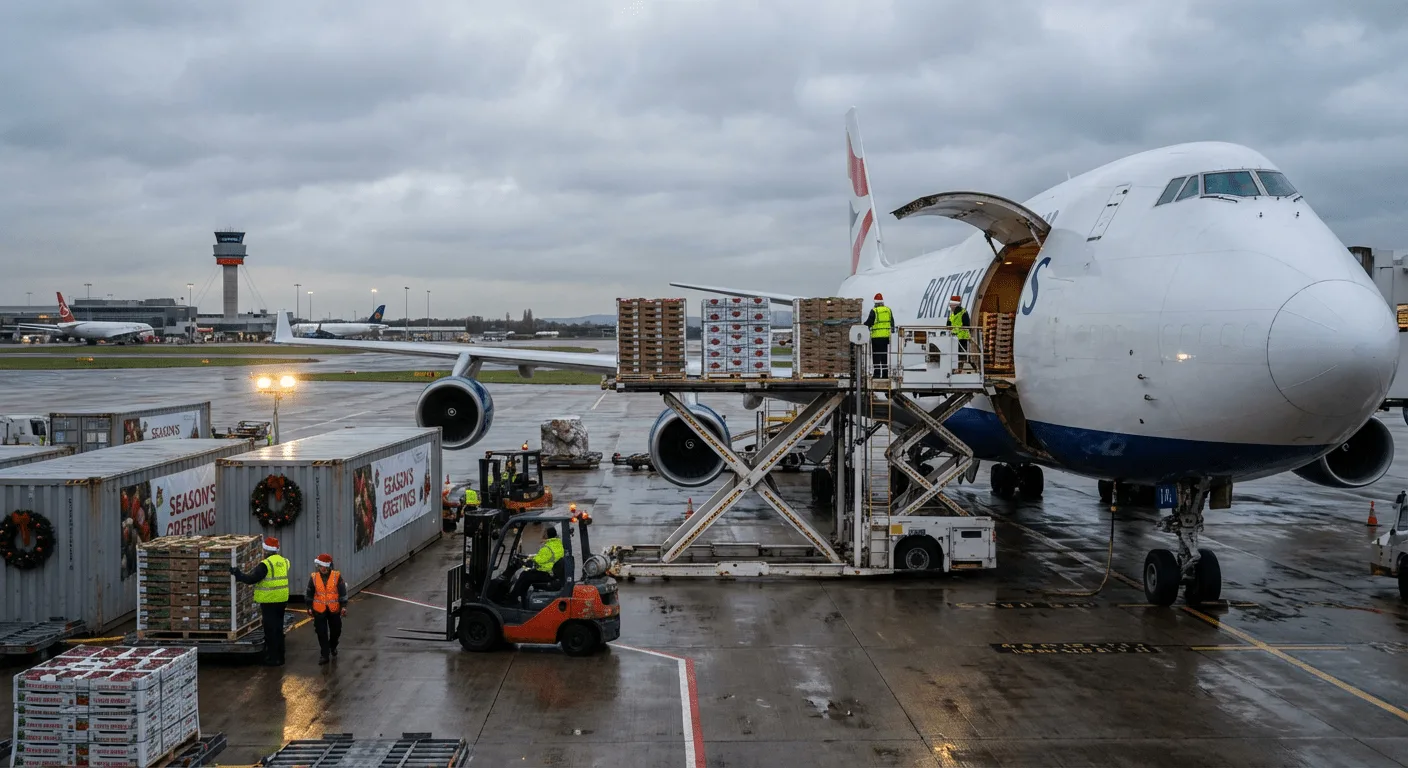
Christmas air cargo runs on a different rhythm than most imagine. While consumers shop festive aisles in December, the bulk of seasonal merchandise shipped months earlier by sea. The real Christmas rush in air freight centres on perishables, e-commerce parcels, and time-critical shipments that cannot wait.
Most festive goods ship before October. Air freight serves a selective but essential role during the holiday season, moving three main categories: fresh food that spoils quickly, online orders that promise fast delivery, and urgent industrial cargo that keeps supply chains running.
Perishables Drive Christmas Air Freight Demand
Fresh food dominates air export volumes during the festive season. Perishables account for approximately 70-80% of air export volumes for some exporters during Christmas, according to industry data compiled across multiple markets.
Premium items include pomegranates, okra, baby corn, herbs, and specialty vegetables destined for European and Middle Eastern tables. Christmas-related perishable shipments typically peak between late November and mid-December.
“Air freight is essential for these products because speed and freshness are critical. Short transit times reduce handling and help maintain quality, especially for premium international markets.”
— Kaushal Khakar, CEO of Kaybee Exports
The strongest international markets for perishable shipments include the UK, Europe, and the Middle East. Roses from Kenya reach European markets. Chilean cherries arrive in Asia. Norwegian salmon is delivered fresh to restaurants worldwide through coordinated air cargo networks.
The Cold Chain Challenge
Perishable products deteriorate from the moment of harvest or catch. Success requires precise temperature-controlled conditions throughout the entire transport chain to slow biological degradation.
The cold chain describes an unbroken sequence of climate-controlled environments from origin to destination. This includes pre-cooling facilities, refrigerated transport, climate-controlled warehouses, and temperature-regulated aircraft holds. Breaking the cold chain even briefly can compromise entire shipments.
Cut flowers last 5-7 days under optimal conditions. Fresh seafood remains premium quality for approximately 48 hours. Berries begin losing firmness within days. A salmon losing $2 per kilogram in value daily makes air freight costing $5 per kilogram economical if it arrives three days sooner than ocean transport.
Modern airports serving perishable cargo markets maintain specialised facilities with multiple temperature zones for different product requirements. Miami International Airport handles over 66% of all perishable imports and almost 90% of all flower imports into the United States. The airport processes 1.92 million tonnes of international air freight annually.
Growing Demand for Supply Chain Visibility
Customers increasingly demand complete visibility of their perishable supply chains. They want real-time temperature monitoring to maintain product quality and reduce waste. This pressure drives investment in tracking technology and handling infrastructure.
“Customers want to see what is changing in their supply chain at a day-to-day level to save themselves money and show their consumers that they are also targeting waste and protecting the environment.”
— Quint Wilken, Panalpina Regional Business Development Manager for Perishables
Airport infrastructure for perishables handling remains a significant challenge, particularly in origin countries such as Latin America. Gaps in ground handling facilities can compromise even the best air transport services.
Major carriers are responding with specialised products. Lufthansa Cargo offers Fresh/td covering transport planning, temperature-controlled environments, and direct deliveries. Etihad Cargo moves perishables in a 50-50 split between belly cargo and freighter operations, with key routes including Africa to Europe out of Kenya and chilled meat from Australia to Europe.
The Perishables Market in Numbers
The global food logistics industry reached an estimated value of $162 billion in 2024. Fresh produce transported by air rose by 8% during the year, demonstrating sustained growth in this specialised sector.
Market composition shows clear categories:
- Fruit and vegetables: 29% of perishable air cargo
- Fish: 21% of perishable air cargo
- General perishables: 18% of perishable air cargo
- Flowers: 13% of perishable air cargo
- Meat: 10% of perishable air cargo
- Cool goods: 6% of perishable air cargo
Growth rates vary by category. Cool goods volume increased 45% year-on-year. Meat volume increased 21% year-on-year. Melbourne’s outbound meat shipments rose 55% year-on-year, while South African meat exports by air nearly doubled compared to the previous year.
Regional specialisation shapes trade flows. Australia exported more than 50% of all meat shipped by air globally. Kenya, Ecuador, and Colombia lead flower exports, with Kenya accounting for 30%, Ecuador 27%, and Colombia 16% during peak Valentine’s period. Norway dominated fish exports, accounting for 46.54% of air-transported chargeable weight from November 2023 to February 2024.
December Capacity Constraints
December presents operational challenges for air cargo. The increase in passenger travel during the holiday season reduces available cargo space in passenger aircraft bellies. Airlines face pressure from simultaneous peaks in baggage volumes and e-commerce cargo demand.
This capacity squeeze affects pricing and availability. Shippers with flexible timing ship earlier. Those requiring December delivery pay premium rates for scarce space.
The timing reality surprises many outside logistics. Most consumer goods including decorations, clothing, and general merchandise ship by ocean freight well before October. These goods must be on shelves by November to capture the shopping season.
“These goods need to be on shelves by November. People in Europe and the US usually spend the Christmas holidays with family rather than shopping.”
— Industry logistics experts on seasonal planning
E-commerce drives significant volumes during December. Online orders with fast delivery promises require air transport. This is a global festival, so e-commerce couriers drive substantial volumes across international networks.
Qantas Freight Scales Up for Christmas
Qantas Freight provides a practical example of Christmas air cargo operations. The carrier unveiled a specially decorated ‘Santa’s Freight’ aircraft to celebrate the festive season and handle increased demand.
The numbers demonstrate scale:
- 5% increase in volumes compared to last year
- 550 additional flying hours across November and December
- 3,000 tonnes of additional domestic capacity
- More than 50 million kilos of freight this Christmas
- 11 million kilometres expected to be travelled by the domestic freighter fleet this year
Qantas Freight operates 20 domestic freighters, including 12 dedicated freighters for Australia Post, increasing to 16 during Christmas. The fleet includes six A321 freighters and five international freighters, plus cargo space in passenger aircraft belly holds.
The cargo mix includes packages, mail, fresh produce, seafood, meats, flowers, and critical supplies. Mangoes and prawns feature prominently among Australian perishables moving to domestic and international destinations.
Timing, Coordination, and Market Windows
Successful perishable air cargo requires precise coordination across multiple stages. Harvesting, processing, ground transport, flight scheduling, and customs clearance must align to meet tight market windows.
Roses cut Monday morning in Kenya must reach Amsterdam auctions by Tuesday to capture the midweek market. This demands coordinated logistics across continents with no room for delays.
International food shipments face strict phytosanitary and veterinary regulations requiring certificates and inspections at destination countries. Delays in documentation or inspection can be as damaging as transport delays for time-sensitive products.
Speed to market matters. Getting quick clearance by food control regulators reduces dwell time and avoids double-handling. Process efficiency is fundamental to maintaining product quality and commercial value.
Technology and Standards Improve Reliability
The industry is deploying new technologies to improve cold chain reliability. Wireless temperature sensors provide continuous monitoring throughout the journey. Blockchain systems create transparent records of handling conditions. Predictive analytics help identify potential problems before they compromise shipments.
IATA has developed industry-wide standards, training programmes, and specialised handling protocols to maintain food safety and optimise delivery speed. These standards help ensure consistent quality across different carriers and handling facilities.
Specialised carriers invest in appropriate infrastructure and train staff in proper handling of perishable goods. Temperature-controlled facilities, trained personnel, and integrated logistics solutions separate basic cargo handling from perishables expertise.
Sustainability and Economic Trade-offs
Air transport costs 10-15 times more per kilogram than ocean shipping. This premium only makes economic sense for products where speed preserves sufficient value to justify the cost difference.
The sustainability equation is complex. Aviation emissions are significant, but air freight also reduces food spoilage and waste. Getting fresh food to market quickly means less product deteriorates during transport or sits unsold.
“Shipping perishable goods by air not only saves critical time but also supports sustainability by reducing food spoilage and waste.”
— Industry analysis on air cargo and food waste
The industry is responding through fuel-efficient aircraft, carbon offset programmes, and advanced technologies to improve cold chain efficiency. Better planning and coordination reduce unnecessary flights and optimise load factors.
A Planned Peak, Not Panic
The logistics industry views Christmas as a planned peak period requiring disciplined execution rather than last-minute chaos. Capacity is booked months ahead. Schedules are adjusted. Additional resources are deployed according to tested plans.
Sea freight continues to dominate festive goods transport, though it faces challenges including port congestion, blank sailings, and slow steaming affecting schedule reliability. Air freight fills the gaps where speed matters most.
Emerging markets including China, India, and Vietnam are driving growth in perishables transport. Demand is becoming year-round rather than seasonal as consumers expect fresh products constantly available.
The growth in perishable goods volumes highlights the vital role air travel plays in helping farmers, production companies, and traders get their produce from farm to supermarket shelf. This is global trade operating at speed, with air cargo networks enabling fresh food supply chains that would have been impossible a generation ago.
Christmas air cargo is about fresh food moving fast while most festive freight shipped months earlier. Understanding this rhythm helps freight forwarders position services effectively, book capacity strategically, and serve customers profitably during the year’s most demanding season.