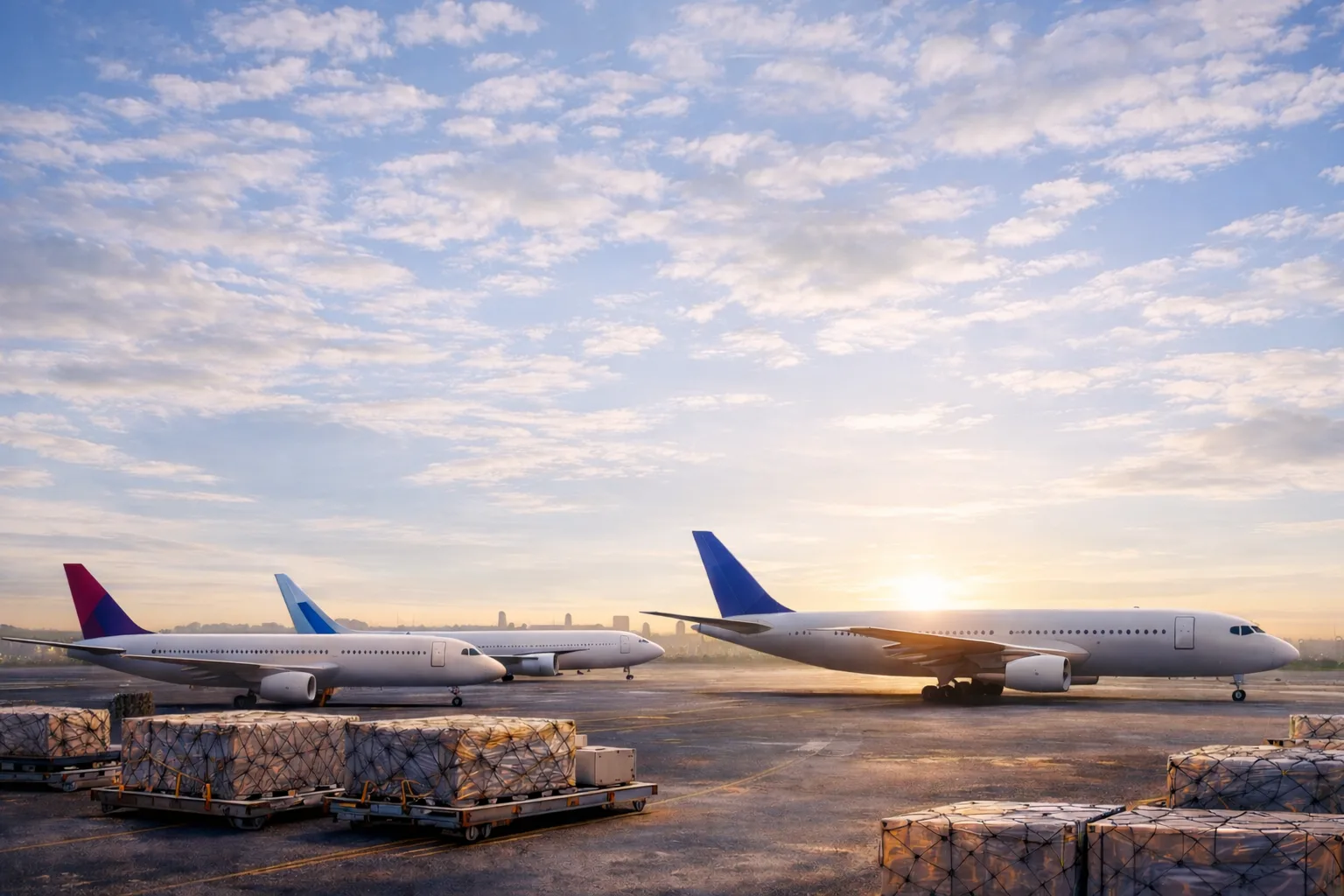
Global air cargo markets face unprecedented. Military escalation in the Middle East has withdrawn 18% of worldwide air freight capacity from service. Major hubs in Doha, Dubai, and Abu Dhabi suspended commercial operations. The conflict struck just as the sector posted record growth.
February 2026 data showed 6% year-on-year demand growth before strikes commenced on February 28. Within days, airspace closures across the UAE, Qatar, Bahrain, Kuwait, Iraq, and Iran eliminated critical capacity on key corridors.
Regional Growth Before the Crisis
Middle Eastern carriers delivered strong performance throughout 2024. The region saw a 13% increase in air cargo demand compared to 2023, according to IATA data. These airlines handled 13.6% of cargo transported internationally in 2024.
Global air cargo demand surged 11.3% in 2024, driven by e-commerce growth and Red Sea disruptions. Ships using the Suez Canal dropped 22% in 2023-24 due to attacks, pushing cargo to air freight. Average yields remained 39% higher than 2019 levels despite softening from pandemic peaks.
“Air cargo was the standout performer in 2024 with airlines moving more air cargo than ever before. Importantly, it was a year of profitable growth.”
– Willie Walsh, Director-General of IATA
Saudi Arabia’s National Aviation Strategy targets 4.5 million tonnes of annual cargo by 2030. The Asia-Pacific region led global growth with 14.5% year-on-year demand increase, handling 34.2% of global air cargo in 2024. European carriers posted 11.2% growth, controlling 21.5% of total air cargo.
Immediate Capacity Withdrawal
The conflict removed 16-18% of global air cargo capacity without warning. Impact varies dramatically by market. India faces 50-70% capacity loss as Qatar Airways, Emirates, and Etihad can no longer serve that corridor.
Freighter and passenger-belly capacity dropped nearly 40% on the Asia-Middle East-Europe corridor. This route carried 80% of India-Europe cargo before the crisis, affecting vaccines and pharmaceutical delivery to European markets.
Major integrators face severe operational constraints. FedEx suspended all flights in and around the Arabian Gulf. UPS operations are similarly crippled. Qatar Airways Cargo remains grounded as Qatari airspace stays closed. Qatar operates close to 30 freighters, with the majority currently displaced outside Doha.
Rate Impact Across Corridors
Air cargo spot rates increased 5% to USD 2.58 per kilogram in February before the conflict escalated. Rates have since accelerated sharply across multiple lanes:
- Southeast Asia-Europe: Up more than 6% to $3.82/kilogram
- South Asia-Europe: Up 3%
- South Asia-United States: Up 5%
- Middle East-Europe: Jumped 8%
- China-United States: Up 15%
- Europe-North America: Up 21% year-on-year
Dynamic load factors rose to 62% in February, up two percentage points. Load factors from Asia to Europe reached 80% before the crisis – the tipping point between buyer’s and seller’s markets.
“We saw rates double, triple, quadruple in certain markets. And I think that is likely to happen in these markets as well if the situation prolongs.”
Ocean Freight Adds Complexity
Modal alternatives remain limited. The Strait of Hormuz is fully closed to commercial container traffic. This waterway accounts for 20% of global oil shipments and 30% of global seaborne oil trade.
Ocean carriers MSC and Maersk suspended Suez routings and reverted to round-Africa diversions. The Bab el Mandeb Strait remains avoided. Major maritime carriers suspended bookings for Persian Gulf sailings, including reefer cargo. Bahrain’s port closed for damage assessment.
Ocean freight transit times of 10-20 days make immediate mode shift unrealistic for time-sensitive cargo. Ships diverted around the Cape of Good Hope add 10+ days to delivery schedules.
Energy and Inflation Pressure
Brent crude rose to $88 per barrel, up from $61 at year-end. Prices could exceed $100 per barrel if disruptions continue. Global aviation fuel rose 3.6% to $99.40 per barrel last week. US jet fuel increased from $2.50 to $2.83 per gallon.
Each $10 per barrel increase in oil prices reduces US economic growth by approximately 0.1 percentage points. A sustained 10% increase in oil prices boosts US headline inflation by 28 basis points. If oil prices increase by $10 and remain elevated for three months, inflation would likely rise from 2.4% in January to 3% in May.
“Economic fundamentals point to another good year for air cargo – with oil prices on a downward trajectory and trade continuing to grow. There is no doubt, however, that the air cargo industry will be challenged to adapt to unfolding geopolitical shifts.”
– Willie Walsh, Director-General of IATA
Recovery Timeline and Strategy
Recovery complexity extends beyond conflict resolution. Aircraft and crew sit displaced from intended locations. The industry rule of thumb: one day of requires five to seven days of cleanup.
Freight forwarders charter alternative flights and explore sea-air transload services via the Maldives, Uzbekistan, and Los Angeles. Airlines prioritize humanitarian aid, military cargo, perishables, and pharmaceuticals over general cargo.
Carriers introduce or consider war risk surcharges and fuel surcharges. Ground handling operations face due to local restrictions and staffing limitations.
“Any longer-term rate you agree now could be far too expensive if this is resolved quickly or far too cheap if this takes too long. My recommendation would be to postpone any longer-term tender at the moment for these affected lanes.”
Market Outlook
IATA projected 5.8% global air cargo demand growth for 2025 before the conflict. Air cargo volumes grew 4% year-over-year in 2025, with demand up approximately 6% in the first two months of 2026. Capacity growth matched at 4% in early 2026.
Shippers not using Middle East transshipment hubs will still face commercial impact. Carriers with operational routes will optimize pricing to benefit from reduced market capacity.
“Shippers will not find a way. Shippers will have to pay for the freight forwarders to find a way.”
The global air cargo industry demonstrates resilience through creative solutions. But solutions come at the price of higher logistical costs. Critical supply chains for vaccines, pharmaceuticals, and perishables face potential shortages if disruptions extend for weeks.
The International Chamber of Shipping, European Shipowners, and Asian Shipowners’ Association described the situation as fast-moving and unpredictable. They urged operators to conduct risk assessments and rely on verified information from official sources.
Global air cargo moved from record growth to unprecedented in days. The sector faces weeks of elevated rates, constrained capacity, and complex routing as it navigates this latest macro-event.