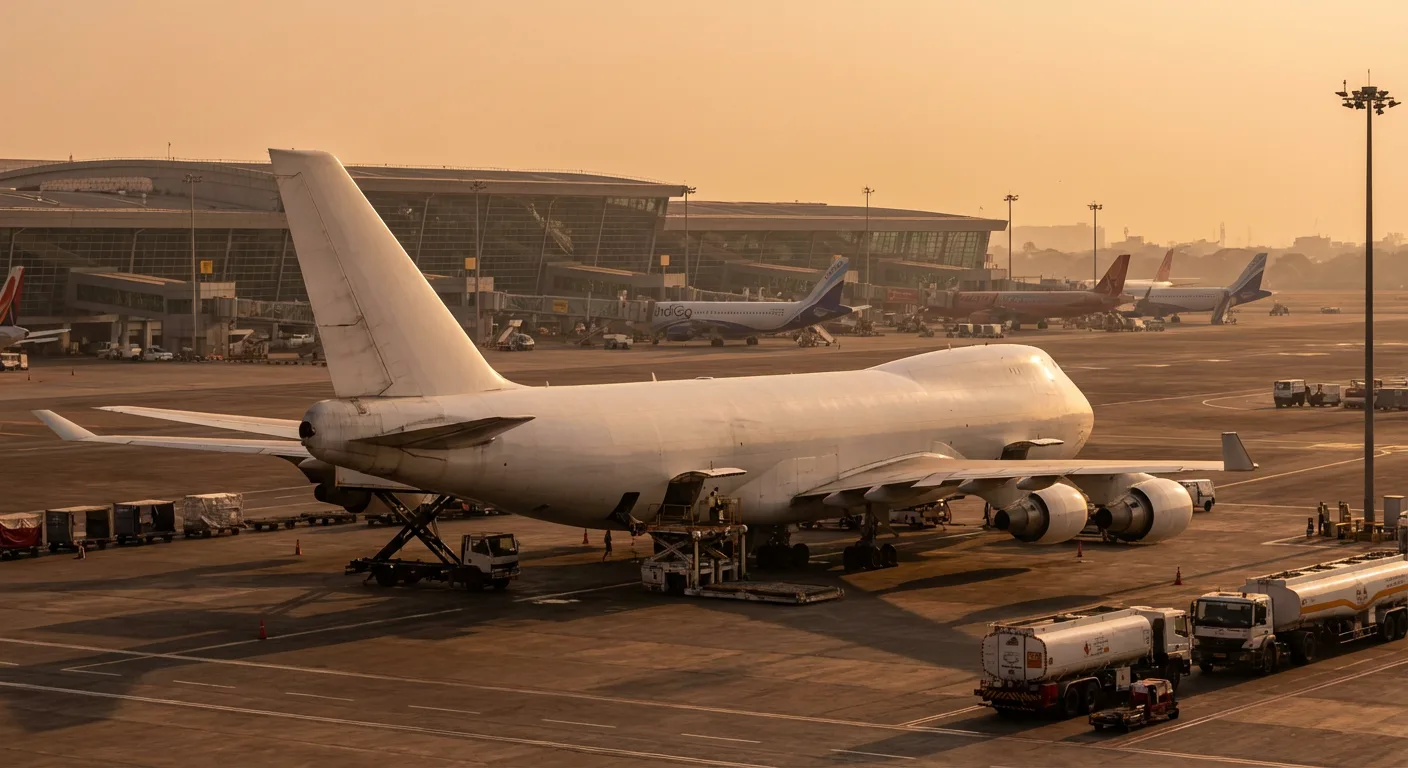
Mumbai’s Chhatrapati Shivaji Maharaj International Airport (CSMIA) will suspend all dedicated freighter operations for ten months starting August 2026. The closure, running through May 2027, enables critical infrastructure upgrades at India’s second-largest cargo hub.
The decision affects a facility that handled 890,000 tonnes of cargo in 2024-25 – nearly a quarter of India’s total air freight volume. For freight forwarders planning Indian cargo routes, this represents a significant operational shift.
Why the Shutdown Is Unavoidable
Mumbai International Airport Ltd (MIAL), operated by the Adani Group, informed aviation stakeholders of the decision on December 11. The work scope includes three major projects that cannot run alongside freighter operations:
- Main runway re-carpeting: The 3,445-metre Runway 09/27 requires complete resurfacing, forcing closure for most of each day
- New Taxiway E construction: A parallel taxiway alongside the 2,925-metre Runway 14/32 will eliminate aircraft crossings on the active runway
- Complete Apron G rebuild: The exclusive freighter parking area has reached end of operational life and requires full pavement reconstruction
MIAL stated the position clearly:
“Mumbai International Airport Ltd thoroughly explored all possible alternatives to maintain freighter operations, but given the operational limitations, the temporary suspension of all cargo flights during the stated period is unavoidable.”
The space constraints are severe. CSMIA operates as the world’s busiest single-runway airport, handling over 55 million passengers annually. With continuous passenger flight operations and no alternative apron space, cargo operations simply cannot continue during construction.
Second Attempt After Industry Pushback
This marks MIAL’s second announcement of a freighter suspension. The airport previously attempted to halt cargo operations starting August 2025, but reversed the decision in May after strong industry backlash, including criticism from IATA.
The revised timeline pushes the start date back twelve months to August 2026. This delay likely provides cargo operators and freight forwarders more time to adjust routing and capacity plans.
Impact on Indian Air Cargo Routes
The ten-month closure affects one of Asia’s most strategically positioned cargo hubs. Mumbai serves as a critical gateway for:
- Export cargo moving from India’s western manufacturing centres
- Import cargo serving Mumbai’s commercial district and wider Maharashtra region
- Cross-trade cargo connecting South Asia with Middle East and African routes
Freight forwarders working India-origin or India-destination cargo will need to reassess capacity on key tradelanes during the closure period. The airport currently handles about seven to eight cargo flight departures daily – capacity that must shift elsewhere or absorb into belly-hold operations.
Space Constraints Drive Decision
MIAL emphasised the unique operational challenges:
“Chhatrapati Shivaji Maharaj International Airport (CSMIA) is among the most land-constrained airports globally and the only single-runway airport handling over 55 million passengers annually.”
With Apron G designated exclusively for freighters, and no alternative apron available, the equation is simple: construction work and cargo flights cannot coexist.
Navi Mumbai Airport as Alternative
The timing aligns with the opening of Navi Mumbai International Airport (NMIA), which began commercial operations on December 25, 2025. MIAL expects freighter operations to shift to the new facility during the CSMIA closure.
NMIA provides cargo operators with purpose-built infrastructure and room for growth – advantages Mumbai’s congested main airport cannot match. For freight forwarders, this transition may introduce:
- New handling facility procedures and documentation workflows
- Different ground handler relationships and service agreements
- Adjusted transit times for door-to-door (D2D) cargo moving to and from Mumbai city
Operators were asked to confirm their intent to commence NMIA operations by May 5, 2025, giving stakeholders advance notice for the eventual transition.
Infrastructure Upgrades Boost Long-Term Capacity
While the ten-month closure creates short-term disruption, the infrastructure improvements promise long-term benefits. The new Taxiway E will run parallel to Runway 14/32, eliminating the need for aircraft to cross active runways – a capacity constraint that currently limits throughput.
MIAL confirmed:
“Since freighter operations are exclusively handled on Apron G, and no alternative apron is feasible due to continuous passenger flight operations and space constraints, we regret to inform you that freighter operations cannot be accommodated during this interim period.”
The rebuilt Apron G and resurfaced main runway position Mumbai airport for higher cargo volumes when freighter operations resume in June 2027.
What Freight Forwarders Should Do Now
SME freight forwarders managing India cargo routes should take action today:
- Review your Mumbai exposure: Identify cargo volumes moving through CSMIA between August 2026 and May 2027
- Map alternative routings: Compare capacity at Delhi, Bengaluru, Chennai and the new Navi Mumbai airport
- Quote proactively: Build new routing scenarios now to maintain speed when clients request quotes
- Communicate early: Inform clients with regular Mumbai cargo about the closure and revised options
The closure timeline provides advance warning. Forwarders who plan routing alternatives now will quote faster and win more business when the suspension begins.
Plan India Routes Now
The August 2026 start date may seem distant, but capacity planning starts today. Freight forwarders managing complex multi-leg routes need tools that compare airport options, quote D2D alternatives, and adjust quickly when infrastructure changes.
Mumbai’s cargo suspension reminds us that route planning requires flexibility. The ability to quote multiple routings fast – comparing carriers, airports and service levels in one workflow – separates forwarders who win cargo from those who lose quotes to faster competitors.
India’s air cargo capacity is shifting. Quote the complicated stuff, fast.