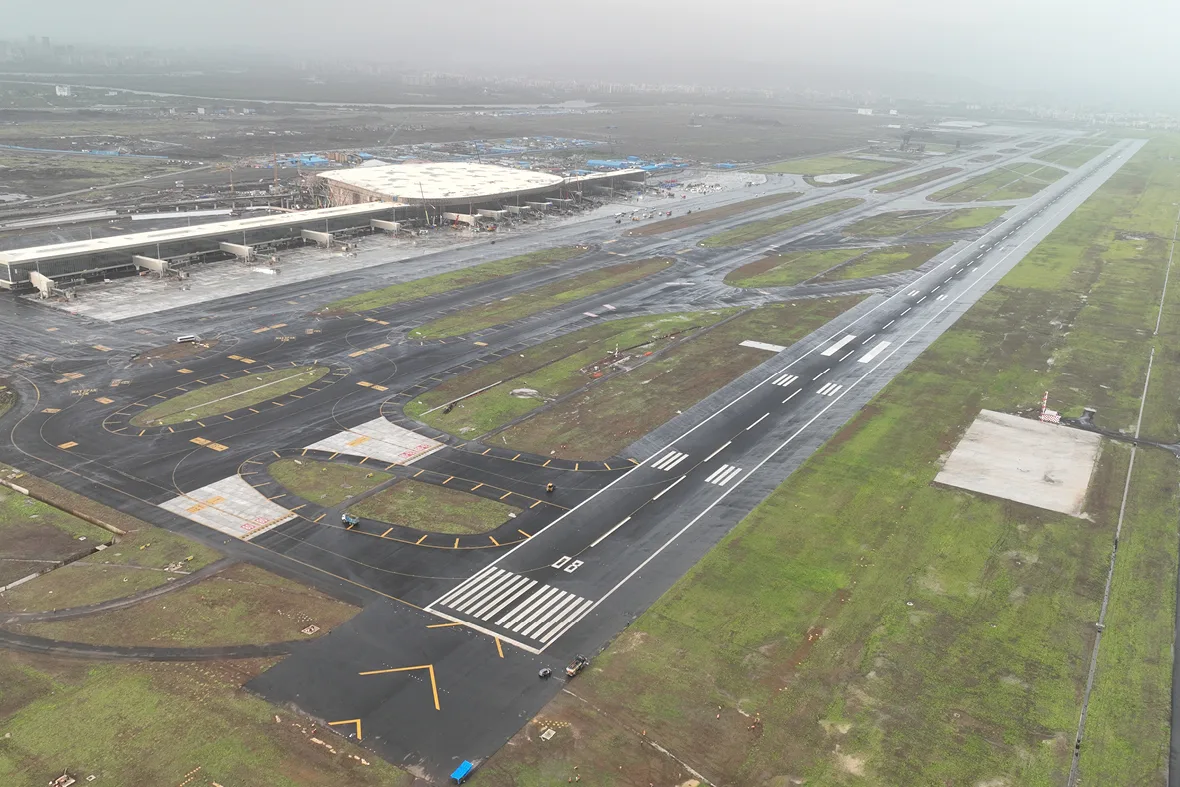
India takes a major step forward this week. Navi Mumbai International Airport (NMIA) opens on December 25, 2025, making Mumbai the first Indian city to operate two airports. But this is not just another passenger terminal. NMIA is built with cargo at its core from day one.
The airport launches with 0.5 million metric tonnes of annual cargo capacity. That scales to 3.25 million metric tonnes in later phases. Seven dedicated freighter stands go live immediately, expanding to 11 in the final configuration. Wide-body aprons, automated terminals and 49 truck docks with full shipment tracking form the backbone.
Cargo first, not an afterthought
For decades, Maharashtra relied almost entirely on Chhatrapati Shivaji Maharaj International Airport (CSMIA) for air cargo. That facility, constrained by space and a single crossing runway, handled 54.8 million passengers in 2024. It has limited room to grow.
NMIA changes the model. Cargo is not bolted on. It is the centrepiece. The facility includes temperature-controlled corridors for cold-chain integrity, dedicated zones for dangerous goods, valuables storage, live animal handling and regulatory offices. A Pharma Excellence Centre with GDP-compliant zones supports life sciences exports. A dedicated perishables cargo village with farm-to-flight cold chain corridors serves Maharashtra’s agricultural base.
The airport holds certifications including Regulated Agent, Regulated Agent Third Country, Good Distribution Practise and CEIV. Operations are cashless and paperless, supported by blockchain-enabled digital customs. Robotic sorting and AI-enabled monitoring accelerate throughput.
Multimodal advantage
NMIA sits less than 20 kilometres north of JNPT (Jawaharlal Nehru Port Trust), India’s largest container port. JNPT is set to reach 10 million TEUs by 2027. Few regions in Asia can match a world-class port and a cutting-edge airport operating in tandem, barely 20 kilometres apart.
This proximity enables sea-air transhipment and multimodal logistics similar to Rotterdam-Schiphol and Dubai models. The airport integrates air, road, rail and planned water transport. The Mumbai Trans Harbour Link and metro connectivity reduce transit times and improve supply chain predictability.
“From the outset, NMIA has been envisioned as more than a passenger gateway. Cargo is not an afterthought; it is the very centrepiece of its design.”
The location matters. NMIA is approximately 40 kilometres east of South Mumbai and 35 kilometres southeast from CSMIA. It sits in a metropolitan area of 2.6 million people within a wider region of 26 million. Maharashtra already accounts for around 16% of India’s exports.
Economic impact and scale
The numbers are significant. NMIA could add INR 50,000 crore (US$5.6 billion) annually to Maharashtra’s trade value by 2035. Over 200,000 jobs are expected across logistics, warehousing and allied services. The development is set to catalyse warehousing zones and cold-chain facilities across the region.
The airport is a public-private partnership. Adani Airport Holdings Limited holds a 74% stake. City and Industrial Development Corporation (CIDCO) holds 26%. Adani already operates seven other major airports in India, including Mumbai’s CSMIA. Construction began in October 2016.
Initial investment totals USD 2.2 billion for the first two phases. A third phase will see Adani invest USD 3.4 billion to expand capacity. Adani Airport Holdings aims to raise USD 3 billion by 2027 and already secured USD 1 billion in project financing in June 2025. The group targets 70% non-aeronautical revenue by 2030.
Passenger operations and expansion
NMIA opens with 20 million passengers of annual capacity. That expands to 90 million once fully operational. A second terminal is planned for mid-2029, raising capacity to 50 million passengers.
Three airlines operate from day one: IndiGo, Akasa Air and Air India Express. They connect to 16 domestic destinations with 23 scheduled daily departures. Initial operations run between 08:00 and 20:00, handling up to 10 aircraft movements per hour and 120 air traffic movements daily.
The airport spans 1,160 hectares. It is designed as a multimodal greenfield facility integrating multiple transport modes. The dual-airport strategy with CSMIA aims to decongest the existing hub, which has limited expansion potential.
India’s aviation growth trajectory
NMIA arrives as India’s aviation sector accelerates. IATA projects a 5.6% average annual growth rate over the next twenty years. An additional 425 million annual passenger journeys are expected by 2044. Air passenger journeys per 1,000 inhabitants will rise from 148 to 258 trips.
The airport positions Maharashtra as a major Asian logistics hub. It introduces several firsts for Indian air cargo: fully automated terminals, robotic sorting, AI-enabled monitoring and blockchain-enabled paperless customs. Digital systems and integrated cargo handling platforms aim to reduce dwell times and improve supply chain predictability.
What it means for forwarders
NMIA opens new routing options for cargo solutions providers. Dedicated freighter capacity, temperature-controlled facilities and multimodal connectivity reduce transit times. The airport supports pharmaceuticals and perishables with specialised infrastructure. Digital systems and automated terminals cut turnaround times by up to 40%.
The facility meets international cargo handling standards and holds multiple certifications to support cross-border trade. Strategic proximity to JNPT enables sea-air transhipment and opens complex routing opportunities. The development is expected to drive warehousing and cold-chain infrastructure across the region.
Quote the complicated stuff, fast. NMIA gives forwarders new capacity, new routing and new speed on key lanes. Compare rates, book direct and track milestones in one portal. No subscription fees. No territory limits.
The airport opens December 25. Operations start today.