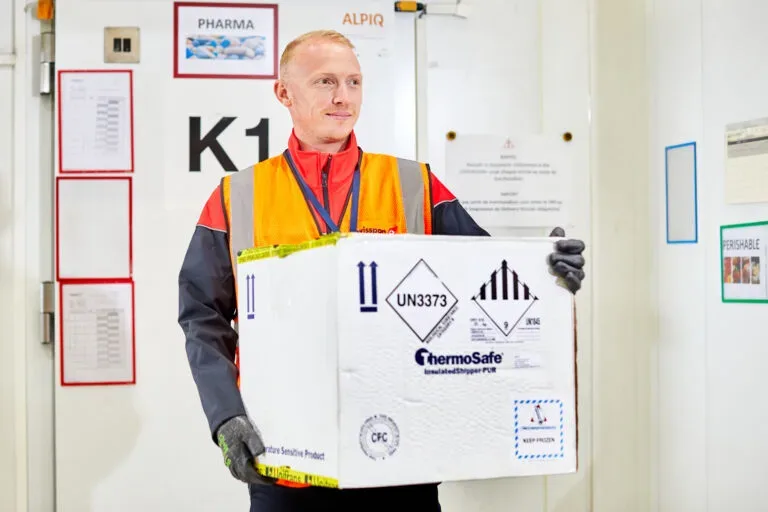
Swissport now operates 24 certified pharmaceutical centres globally, with Düsseldorf earning IATA CEIV Pharma certification as the latest addition. The expansion responds to one clear driver: pharma cargo is changing fast, and the handling infrastructure must keep pace.
For freight forwarders managing temperature-sensitive shipments, this matters. Pharmaceutical cargo now represents roughly 10% of Swissport’s 5 million tons handled in 2024. That share is growing. The shift toward biologics and temperature-sensitive therapies demands specialised handling at scale.
What’s driving the expansion
The pharmaceutical industry has moved beyond traditional tablets and vials. Biologics and gene therapies require strict temperature control, often within 2-8°C ranges, throughout the supply chain. Break that chain, and the product fails. The financial and human cost is high.
“The primary driver for our cold chain reinforcement is the fundamental shift in pharmaceutical manufacturing toward biologics and temperature-sensitive therapies. This evolution requires a specialised handling infrastructure at a global scale.”
— Dirk Goovaerts, CEO Continental Europe, Middle East, Africa, India & Global Cargo Chair, Swissport
Swissport accelerated investment in 2025. The company added dedicated pharma facilities in Manchester, New York JFK, and Shanghai. Recent certifications also include hubs in Madrid, London Heathrow, Dublin, Nairobi, Montréal, Toronto, Miami, and Basel.
The scale of operations
Swissport operates 65 pharma-capable warehouses across its network. Of those, 24 hold full certification under industry standards including IATA CEIV Pharma, British MHRA, and Good Distribution Practice (GDP).
The distinction matters. Pharma-capable means basic temperature control. Certified means audited processes, trained personnel, validated equipment, and documented compliance at every touchpoint.
The Basel blueprint
The company’s Cool and Connect air cargo facility, launched in Basel in 2024, serves as the model. Swissport is replicating that infrastructure across strategic life science hubs. The focus: dedicated 2-8°C cool container infrastructure with end-to-end visibility.
Digital monitoring is non-negotiable
Temperature control is worthless without visibility. Swissport integrates digital monitoring systems across all certified facilities. The systems provide:
- Real-time temperature tracking at all control points
- Proactive alerts for deviations before product damage occurs
- Complete traceability with recorded interface transactions between stakeholders
- Chain of custody documentation for regulatory compliance
Goovaerts explained the practical value: “The system alerts us to any temperature issues in real-time, allowing us to quickly intervene and prevent product loss or damage.”
For forwarders, this means fewer claims, faster exception resolution, and documented proof of proper handling. When audits come, the data exists.
Partnership approach
Swissport doesn’t operate in isolation. The company partners with airports, manufacturers, freight forwarders, and ULD service providers to build industry-wide risk elimination and transparency.
This collaborative model matters because pharmaceutical logistics failures rarely stem from a single point. A temperature excursion can occur during tarmac transfer, warehouse handover, or ULD preparation. Fixing one link without addressing the others solves nothing.
What forwarders should watch
The pharmaceutical segment is no longer niche. With biologics and personalised medicines expanding, temperature-sensitive cargo will represent a larger share of air freight volumes. Three trends stand out:
- Certification requirements are tightening. Regulators and manufacturers demand documented handling standards. Facilities without certification will lose access to premium pharma lanes.
- Digital documentation is becoming mandatory. Paper-based temperature logs and manual handovers won’t meet compliance standards. Real-time digital monitoring is the baseline.
- Geographic coverage is expanding. Pharmaceutical manufacturing and distribution are no longer concentrated in Europe and North America. Asia-Pacific hubs like Shanghai are critical nodes in the cold chain.
Impact on rate negotiations
Certified pharma handling commands premium rates. Forwarders managing pharmaceutical accounts need access to certified facilities on key lanes. A gap in the cold chain means rejected shipments and re-routing costs that eliminate margin.
Swissport’s expanded network offers more routing options. For forwarders, that means better negotiating position with shippers and more flexibility when primary routes face capacity constraints.
The competitive landscape
Swissport isn’t alone in targeting pharmaceutical cargo. Ground handlers, warehouse operators, and integrated carriers are all investing in certified cold chain infrastructure. The competitive pressure benefits forwarders by expanding capacity and driving service improvements.
However, not all certifications are equal. CEIV Pharma, MHRA, and GDP standards represent the top tier. Facilities claiming “pharma capability” without third-party certification carry higher risk.
Quote faster. Ship smarter.
Pharmaceutical shipments demand speed and precision. Complex routing across multiple carriers and temperature-controlled facilities takes time to quote manually. Forwarders need tools that compare options fast.
CSN provides instant access to vetted partners and live rates across global networks. Quote multi-leg routes, compare airport-to-airport (A2A) and door-to-door (D2D) options, and book direct. No subscription fees. No platform tax.
Built by freight people, for freight people. Join free and ship today.
Final takeaway
Swissport’s expansion to 24 certified pharma centres reflects real market demand. Temperature-sensitive pharmaceuticals are growing fast. The infrastructure must match.
For forwarders, this means more certified capacity on key lanes, better digital visibility, and stronger compliance documentation. The competitive advantage goes to those who can quote and book cold chain capacity quickly, with confidence in handling standards.
Pharmaceutical transport is evolving. The winners will be those who adapt fastest.