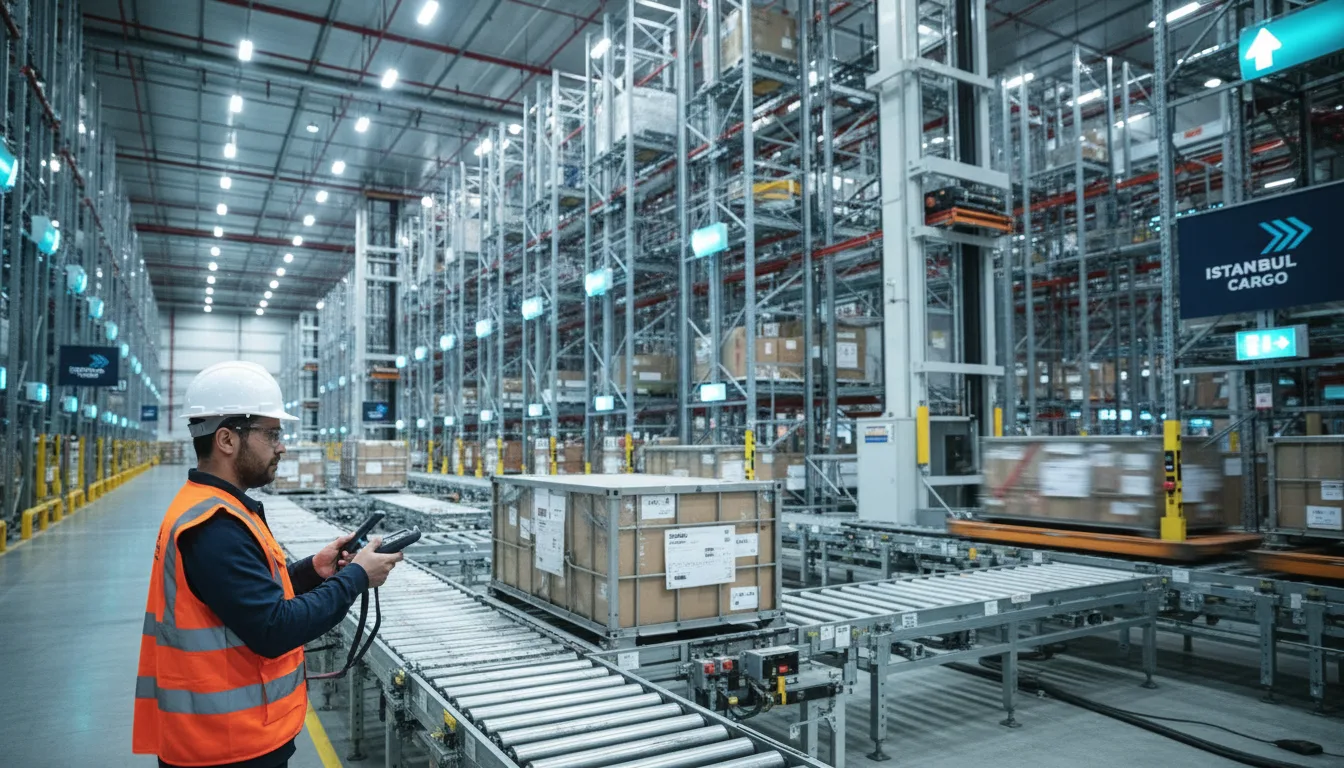
Lödige Industries has delivered one of the world’s most advanced air cargo terminals at Istanbul Airport, equipping Turkish Cargo with fully automated infrastructure that more than triples previous handling capacity. The facility showcases how intelligent orchestration and modular automation are reshaping global air freight operations.
Scale and Capability That Redefines Regional Air Cargo
The new terminal spans 300,000 square metres with capacity to handle four million tonnes per year. That scale positions Istanbul as a critical hub for trade between Europe, Asia and the Middle East.
17,000 Automated storage locations with 30 stacking cranes
Specialized zones serve diverse cargo requirements, including 6,000 square metres for temperature-controlled storage, 2,000 square metres for express cargo, 500 square metres for live animals, 5,000 square metres for e-commerce and mail, and 1,000 square metres for high-value secure cargo. Fifteen lifts and integrated warehouse management tie the facility into a single coordinated system.
“Turkish Cargo’s goal is to always deliver the best possible quality to its customers and industry partners. With the brand-new cargo hub at İstanbul Airport, we are able to combine the highest quality standards with the utmost efficiency, making Istanbul the most advanced logistics centre in the world.”
– Turhan Özen, Chief Cargo Officer, Turkish Cargo
Process Automation Beyond Mechanical Systems
Lödige Industries, the global market leader in air cargo terminal technology with 45 years of experience handling 28 million tonnes annually, has deployed its Cargo Professional Suite across the Istanbul facility. The platform connects all processes from landside acceptance through to airside handover, managing ULDs, in-house pallets and consignments in real time.
The suite now includes Cargo Direct, a new module launched in March 2026 that links air waybill data with terminal resources in real time. Each cargo unit is tracked via handheld scanners using WLAN or 5G. The system consolidates shipment data, special handling codes, terminal layout, equipment availability and personnel into a continuously updated activity plan.
System-Guided Workflows at Hub Scale
User interaction reduces to scan-and-confirm steps. The system actively determines the next optimal process step for each unit, reducing operational variability and increasing throughput without expanding infrastructure. Integration with volume and weight data from smart gates with 3D scanning improves ULD build-up density.
Philippe De Backer, CEO of Lödige Industries, noted the system closes the gap between equipment automation and true process automation, helping terminals deliver consistent operational throughput while supporting hub connectivity and schedule resilience.

Modular Design for All Terminal Types
Lödige’s solutions span six core process areas: landside interface, consignment storage, build and break, intra-terminal transport, ULD storage, and airside interface. Each can operate manually, semi-automated or fully automated depending on terminal size and throughput. All systems meet or exceed IATA guidelines, with 24/7 remote monitoring and fast spare parts supply worldwide.
Proven implementations include DHL’s Dubai e-commerce hub, TNT’s Hong Kong facility and Finnair Cargo’s COOL terminal in Helsinki. The modular approach supports phased upgrades, modernisation and retrofit for existing terminals.
For freight forwarders serving Istanbul or other major hubs deploying intelligent terminal orchestration, visibility into real-time handling capacity and milestone tracking becomes a competitive differentiator. Understanding how automation affects cargo flow helps quote accurately and manage client expectations across complex multi-leg routes.